
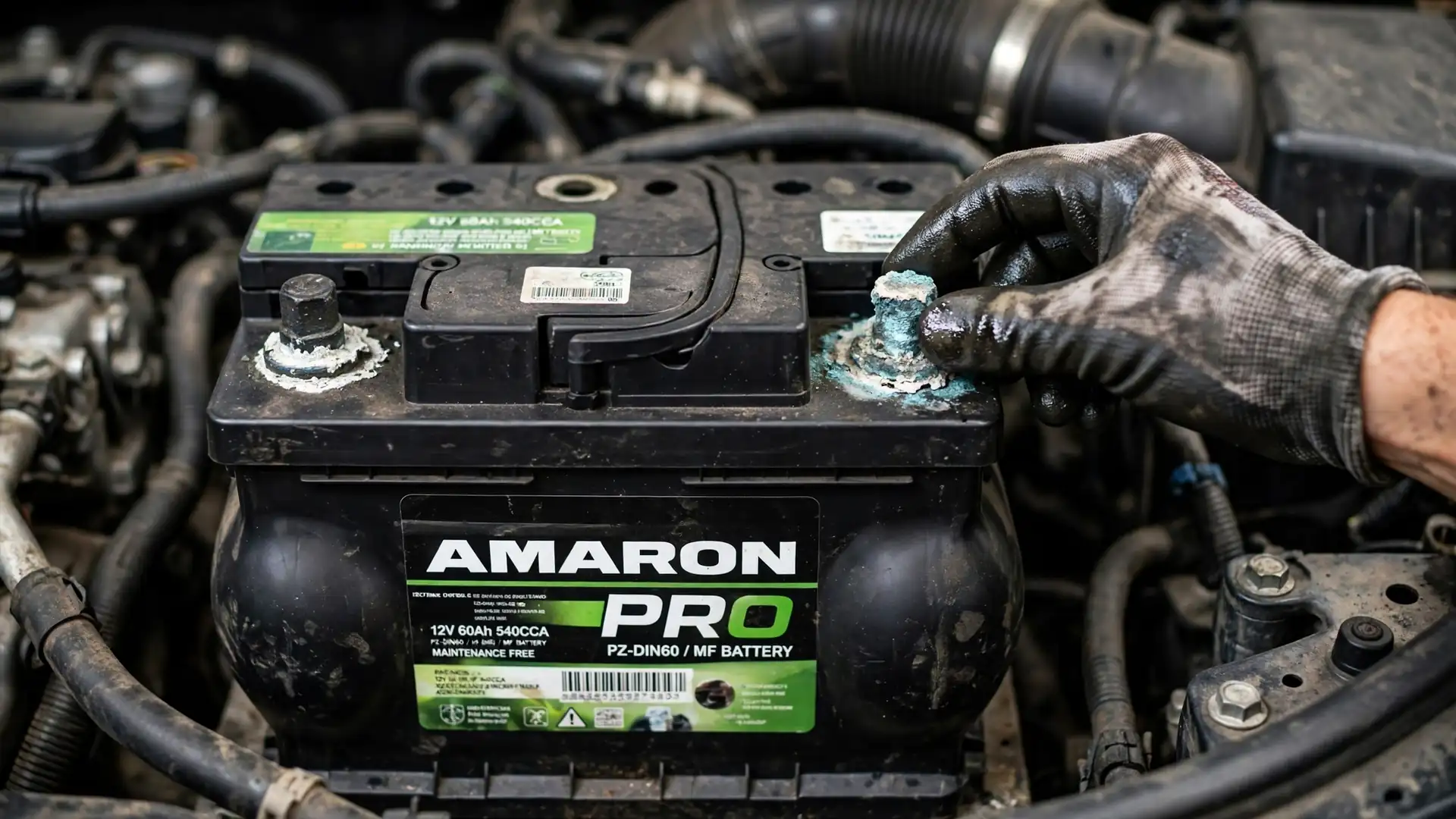
A weak car battery can cause starting problems when you least expect them. Ignoring early warning signs can leave you with a vehicle that will not start. Knowing when to replace the battery can help prevent unexpected breakdowns.
An Amaron battery may need replacement when its resting voltage drops below 12.20 volts, the charge indicator turns white or clear, or its measured cold cranking amps fall below 70% of the rated value.
Other warning signs include slow engine cranking, dim headlights, and a swollen battery case. A battery test can help confirm whether the battery is nearing the end of its service life.
What Are the Signs an Amaron Battery Needs Replacement?
There are 10 confirmed signs an Amaron battery needs replacement:
- Slow engine cranking lasting more than 3 seconds
- Rapid clicking from the starter solenoid at ignition
- Dim headlights and dashboard illumination at idle
- Battery warning lamp illuminated on the instrument cluster
- White or clear charge indicator in the battery lid
- Swollen, bulged, or distorted battery case
- White or blue-green corrosion crust on the terminals
- Resting voltage below 12.20 volts after 6 hours of rest
- Service age above 30 months in UAE operating conditions
- Two or more jump starts within a single month
Each sign carries a measurable threshold. The sections below give the exact figures that separate a rechargeable battery from a battery at end of life.
How Does the Amaron Charge Indicator Show Battery Condition?
The Amaron charge indicator displays 3 colours that report the state of charge and electrolyte level. The indicator sits in the top cover of Amaron Pro, Amaron Flo, Amaron Go, and Amaron Black units. The float ball inside the indicator changes position with electrolyte density.
Indicator colour | Electrolyte condition | State of charge | Required action |
Green | Normal density, normal level | 65% and above | Continue service |
Black or dark | Reduced density, normal level | Below 65% | Recharge and retest |
White or clear | Electrolyte level below the float | Not measurable | Replace the battery |
A white indicator confirms replacement. The electrolyte has evaporated below the sensor float, which happens after sustained exposure to under-bonnet temperatures above 70°C. Amaron seals its calcium-calcium alloy batteries as maintenance-free units, so topping up the electrolyte is not a supported repair.
A black indicator points to a discharge fault rather than a dead battery. Charge the unit at 5 amps for 8 hours, then retest the resting voltage. A black indicator that persists after a full charge cycle confirms sulphation and end of life.
What Voltage Reading Confirms an Amaron Battery Needs Replacement?
A resting voltage below 12.20 volts confirms a failing Amaron battery. Measure the voltage with a digital multimeter after the vehicle has stood for 6 hours with the ignition off. Surface charge from a recent drive inflates the reading by 0.20 volts and produces a false result.
Resting voltage | State of charge | Diagnosis |
12.70 V and above | 100% | Healthy battery |
12.50 V | 90% | Healthy battery |
12.40 V | 75% | Recharge required |
12.20 V | 50% | Load test required |
12.00 V | 25% | Replacement after failed load test |
11.80 V and below | 0% | Replacement confirmed |
Cranking voltage supplies the second measurement. Voltage below 9.60 volts during cranking confirms a failed battery at an ambient temperature of 21°C. Attach the multimeter to the terminals, crank the engine for 15 seconds, and record the lowest reading.
The third measurement covers the charging circuit. A healthy alternator delivers 13.80 to 14.40 volts at idle with the engine running. Readings above 14.80 volts indicate overcharging, which boils the electrolyte and destroys an Amaron battery within 6 months.
How Does Slow Engine Cranking Indicate Amaron Battery Failure?
Slow engine cranking indicates a loss of cold cranking amps inside the Amaron battery. Cranking amps drive the starter motor. A 60Ah Amaron Flo unit delivers 540 CCA when new. Sulphate crystals build on the lead plates as the battery ages, reduce the active plate surface, and cut the current available to the starter.
Replacement becomes necessary once measured CCA falls below 70% of the rated figure. A 540 CCA unit measuring 378 CCA or less on a conductance tester has reached end of life. Workshop conductance testers such as the Midtronics MDX series produce this reading in 10 seconds without discharging the battery.
Crank duration provides a field measurement. A healthy Amaron battery starts a petrol engine within 1.5 seconds. Cranking that extends past 3 seconds, or cranking that sounds progressively slower across consecutive starts, confirms plate degradation.
Why Do Headlights Dim When an Amaron Battery Loses Capacity?
Headlights dim because a degraded Amaron battery holds insufficient reserve capacity to support the electrical load at idle. Reserve capacity measures the minutes a battery supplies 25 amps before dropping to 10.50 volts. An Amaron Pro 80Ah unit provides 140 minutes of reserve capacity when new.
Test the symptom in 3 steps. Park the vehicle, run the engine at idle, and switch on the headlights. Brightness that drops noticeably at idle and recovers when engine speed rises to 2,000 rpm confirms the battery no longer supports the load without alternator assistance.
Interior symptoms accompany the headlight test. Slow power windows, delayed infotainment startup, weak horn output, and flickering dashboard backlighting appear together once reserve capacity falls below 50% of the rated figure.
What Does a Clicking Sound at Ignition Mean?
A rapid clicking sound at ignition means the Amaron battery supplies enough current to energise the starter solenoid but not enough to turn the starter motor. The solenoid engages, voltage collapses under load, the solenoid disengages, and the cycle repeats at 5 to 10 clicks per second.
A single loud click carries a different diagnosis. One click points to a seized starter motor or a failed solenoid contact, not a battery fault. Confirm the difference with a voltage reading. Terminal voltage above 12.40 volts combined with a single click isolates the fault to the starter circuit.
Clicking that stops after a jump start and returns within 48 hours confirms the battery no longer holds charge. Amaron calcium-calcium plates lose charge acceptance permanently once deep discharge occurs 3 or more times.
What Causes Terminal Corrosion on an Amaron Battery?
Terminal corrosion forms from hydrogen sulphide gas escaping past the terminal seal during charging. The gas reacts with the lead post and the copper clamp. White powder on the negative post indicates undercharging. Blue-green crust on the positive post indicates overcharging or acid seepage.
Corrosion raises circuit resistance. A resistance increase of 0.01 ohms across a corroded terminal reduces starter current by 60 amps. Clean the posts with a solution of 1 part sodium bicarbonate to 1 part distilled water, dry the surfaces, and apply dielectric grease.
Corrosion that returns within 30 days of cleaning confirms a case seal failure. Seal failure allows continuous acid vapour escape and requires battery replacement rather than terminal service.
Why Does an Amaron Battery Case Swell in UAE Heat?
An Amaron battery case swells because internal gas pressure rises when heat drives the electrolyte past its gassing voltage. Under-bonnet temperatures in Abu Dhabi and Dubai reach 80°C during July and August, against an ambient peak of 50°C. The polypropylene case deforms at sustained internal pressure.
A swollen case carries an immediate replacement requirement. Case distortion breaks the seal between cell partitions, allows internal short circuits between plate groups, and creates a rupture risk. Vent blockage compounds the pressure.
Overcharging produces the same result at lower ambient temperatures. Verify alternator output at 13.80 to 14.40 volts before fitting a replacement unit, because an uncorrected charging fault destroys the new battery on the same timeline.
How Long Does an Amaron Battery Last in the UAE?
An Amaron battery lasts 18 to 30 months in UAE operating conditions, against 36 to 60 months in temperate climates. Heat drives the difference. Lead acid battery service life halves for every 10°C rise in average operating temperature above 25°C.
Battery Council International data records an average lead acid service life of 30 months across hot climate zones and 58 months across cold climate zones. UAE summer conditions place vehicles at the extreme end of the hot climate range for 5 months of the year.
Read the manufacturing date from the code printed on the battery label or stamped on the case. Amaron uses an alphanumeric code where the letter denotes the month and the digits denote the year. A battery manufactured more than 36 months earlier requires load testing at every service interval, regardless of symptoms. The Amaron Battery Replacement Dubai Complete Guide covers date code reading and replacement scheduling in detail.
What Is the Difference Between a Failing Amaron Battery and a Failing Alternator?
A failing Amaron battery fails at startup, while a failing alternator fails during driving. Both faults produce dim lights and starting trouble, which causes frequent misdiagnosis. The table below separates the two.
Observation | Failing Amaron battery | Failing alternator |
Symptom timing | Cold start, first attempt of the day | During driving, after 20 minutes of running |
Warning lamp | Battery icon at startup only | Battery icon while driving |
Jump start result | Engine starts and continues running | Engine stalls within minutes of cable removal |
Voltage at idle, engine running | 13.80 to 14.40 V | Below 13.00 V |
Resting voltage after 6 hours | Below 12.20 V | 12.60 V and above |
Accessory behaviour | Weak at startup, normal while driving | Normal at startup, degrades while driving |
Audible signature | Clicking at ignition | Whining or growling from the belt drive |
Run the jump start test for the fastest field diagnosis. Disconnect the jump leads after the engine starts and let the engine idle for 5 minutes. An engine that continues running isolates the fault to the battery. An engine that stalls isolates the fault to the alternator or the drive belt.
How Do You Test an Amaron Battery at Home?
Test an Amaron battery in 6 steps using a digital multimeter:
- Park the vehicle and switch off the ignition for 6 hours
- Set the multimeter to the 20 V DC range
- Connect the red probe to the positive terminal and the black probe to the negative terminal
- Record the resting voltage and compare it against the voltage table above
- Start the engine and record the voltage during cranking, watching for the lowest reading
- Record the voltage at idle with the engine running and the headlights switched on
Interpret the 3 readings together. Resting voltage above 12.60 volts combined with cranking voltage above 9.60 volts confirms a healthy battery. Resting voltage below 12.20 volts combined with cranking voltage below 9.60 volts confirms replacement.
Test parasitic drain when the battery discharges overnight without an obvious fault. Set the multimeter to the 10 A DC range, connect it in series with the disconnected negative cable, and wait 45 minutes for the vehicle modules to enter sleep mode. Normal parasitic draw measures 20 to 50 milliamps. Draw above 85 milliamps indicates a circuit fault that discharges a healthy battery within 4 days.
What Causes Early Amaron Battery Failure in the UAE?
There are 7 causes of early Amaron battery failure in the UAE:
- Sustained heat exposure accelerates grid corrosion and water loss from the electrolyte
- Short urban trips below 15 minutes prevent the alternator from restoring the charge consumed at startup
- Extended idling with air conditioning draws 30 to 50 amps while the alternator operates at reduced output
- Aftermarket accessory loads from amplifiers, dashcams, and lighting add continuous parasitic drain
- Loose hold-down clamps allow vibration that cracks the internal plate welds
- Undersized capacity forces the battery to operate at deep discharge on every start cycle
- Charging system faults deliver overvoltage above 14.80 volts and boil the electrolyte
Capacity sizing causes the most avoidable failures. A Nissan Patrol with a V8 engine and full accessory load requires an Amaron Pro 95D31R. Fitting a 60Ah unit to the same vehicle produces deep discharge on every start and reduces service life to 9 months.
Which Amaron Battery Replaces a Failed Unit?
The correct Amaron replacement matches the original terminal layout, case dimensions, and ampere-hour rating. Amaron supplies both JIS and DIN case formats across the UAE range.
Amaron range | Capacity band | Vehicle application | Indicative price |
Amaron Go | 35Ah to 55Ah | Compact hatchbacks and small sedans | AED 280 to AED 380 |
Amaron Black | 55Ah to 65Ah | Mid-size sedans with standard electrical load | AED 340 to AED 430 |
Amaron Fresh | 50Ah to 70Ah | Daily-use sedans and crossovers | AED 390 to AED 500 |
Amaron Flo | 60Ah to 80Ah | Sedans and SUVs with moderate accessory load | AED 450 to AED 580 |
Amaron Pro | 65Ah to 100Ah | Large SUVs, V8 engines, high accessory load | AED 560 to AED 780 |
Common UAE fitments include the Amaron Flo 55B24LS for the Toyota Corolla, the Amaron Flo 46B24LS for the Honda Civic, the Amaron Pro 95D31R for the Nissan Patrol, and the Amaron Pro 105D31L for the Toyota Land Cruiser. The DIN range covers 44Ah, 55Ah, 60Ah, 66Ah, 74Ah, 80Ah, 100Ah, and 110Ah for European vehicles.
Vehicles fitted with automatic stop-start systems require AGM or EFB specification units. Fitting a standard flooded battery to a stop-start vehicle produces failure within 12 months, because the battery management system charges outside the flooded design window. Browse the full range and fitment data at Amaron Car Battery.
How Do You Confirm a Replacement Amaron Battery Is Genuine?
Confirm a genuine Amaron battery through 4 verification checks:
- Locate the holographic seal on the battery label and verify the colour shift across viewing angles
- Read the manufacturing date code and confirm the unit was produced within the last 6 months
- Match the printed part number against the Amaron catalogue specification for the vehicle
- Register the serial number for warranty coverage at the point of purchase
Counterfeit units reach the UAE market with reprinted labels and refurbished cases. A refurbished unit passes an initial voltage test and fails within 90 days, because the internal plates carry existing sulphation.
Purchase from authorised dealers and retain the tax invoice, which functions as the warranty document during a claim. Verification steps for existing units appear in the Amaron Battery Warranty Status Check Online guide.
Frequently Asked Questions
An Amaron battery lasts 18 to 30 months in UAE conditions and 36 to 60 months in temperate climates. Under-bonnet temperatures above 70°C accelerate grid corrosion and shorten service life by roughly half compared to the manufacturer rating.
A jump start restores a single engine start without repairing the battery. An Amaron battery that requires 2 or more jump starts within a month has lost charge acceptance permanently and requires replacement.
A resting voltage of 11.80 volts or below indicates a fully discharged Amaron battery. Resting voltage between 11.80 and 12.20 volts indicates a battery at 25% to 50% state of charge that fails a load test.
A white or clear charge indicator confirms the electrolyte level has dropped below the sensor float. Amaron seals its maintenance-free batteries against topping up, so a white indicator confirms replacement.
Heat drives the difference. Lead acid battery life halves for every 10°C rise in average operating temperature above 25°C. Dubai summer ambient temperatures reach 50°C, which places under-bonnet temperatures near 80°C for 5 months of the year.
Terminal corrosion requires cleaning rather than replacement in most cases. Corrosion that returns within 30 days of cleaning confirms a case seal failure and requires replacement of the battery.
An Amaron battery replacement takes 15 to 30 minutes, covering removal of the old unit, terminal cleaning, fitment of the new unit, and charging system verification. Mobile services across Dubai and Abu Dhabi complete the process at the vehicle location.
A corroded terminal reduces cranking power through added electrical resistance. A 0.01 ohm resistance at the post drops 2.5 V under a 250 A starter load, which leaves under 10 V at the starter motor. Clean terminals restore the full cranking current.
Disconnecting the battery clears stored settings on most vehicles, including radio presets, clock time, and adaptive transmission data. A memory saver connected to the OBD port preserves these settings during replacement.
Replace the Battery Before It Strands the Vehicle
An Amaron battery gives measurable warning across 10 signs before total failure. Resting voltage below 12.20 volts, a white charge indicator, and cranking voltage below 9.60 volts form the 3 readings that confirm the end of service life. Test the battery at every service interval once the unit passes 24 months in UAE conditions, and match the replacement to the vehicle terminal layout, case size, and ampere-hour rating.