
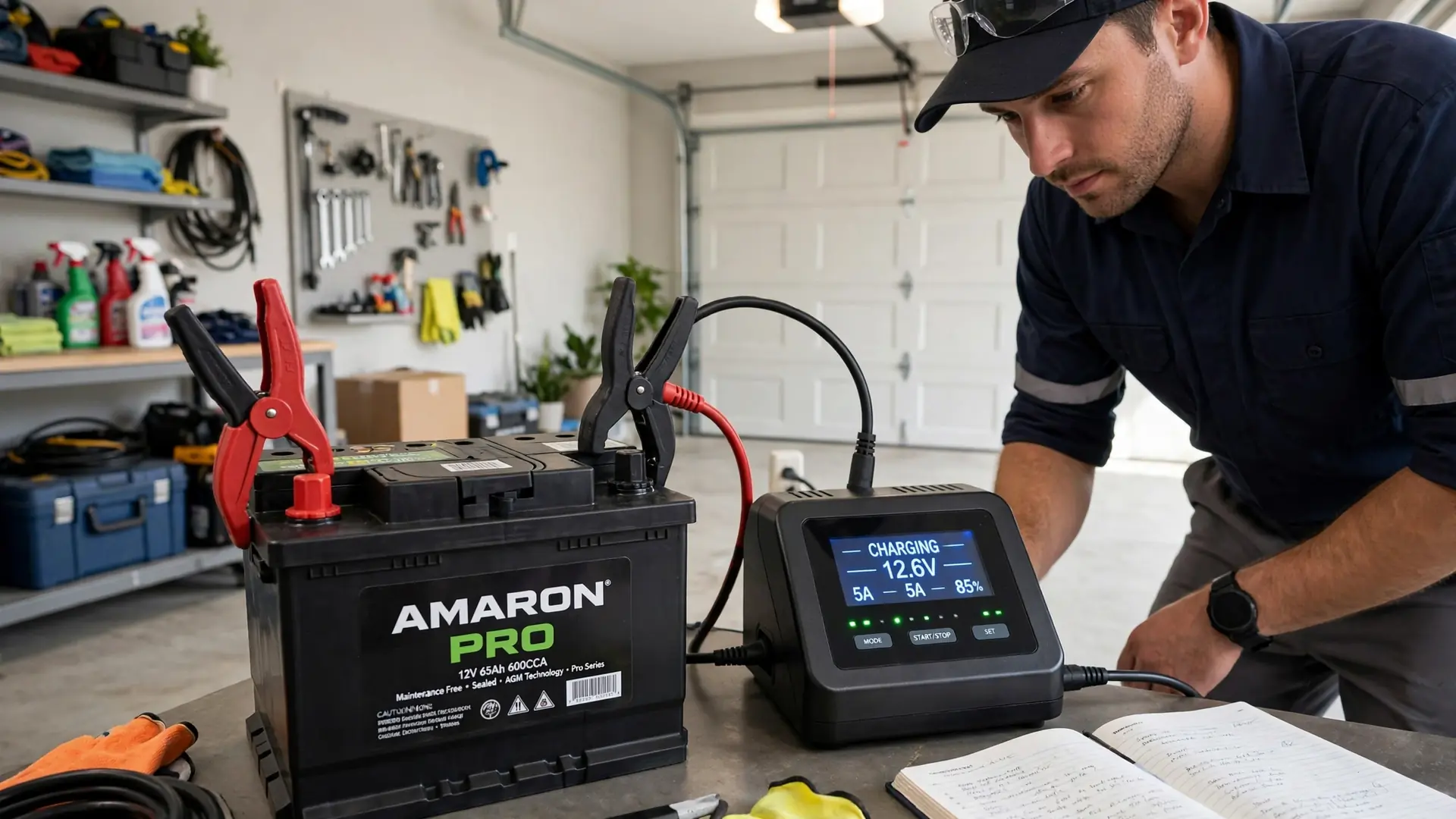
High temperatures, frequent short trips, and poor charging can shorten your car battery’s service life. Regular maintenance can help prevent early battery failure and keep starting performance reliable. Simple checks and driving habits can make a noticeable difference.
You can increase Amaron battery life through practical maintenance actions. Drive for 30 continuous minutes twice a week to help maintain the battery’s charge. Clean the terminals every 30 days and keep the connections secure.
Park in the shade whenever possible and switch off accessories before starting the engine. Test the resting voltage every 30 days and check for parasitic drain above 50 milliamps. Charge the battery before long-term storage and verify that the alternator produces the correct charging voltage.
Always use a battery with the correct case size and CCA rating for your vehicle. These simple maintenance practices can help your Amaron battery perform reliably and reach its expected service life.
How Long Does an Amaron Battery Last?
An Amaron car battery lasts 18 months to 36 months in the UAE and 48 months to 60 months in temperate climates. Ambient temperature, trip length, and charging voltage decide the final figure.
Amara Raja rates the SilvenX grid for factory-charged performance from the day of purchase, so the manufacturing date stamp on the case sets the starting point of the service window.
Usage pattern | Average trip length | Expected service life |
Daily highway commute | 45 minutes | 30 to 36 months |
Mixed city and highway | 25 minutes | 24 to 30 months |
Short urban trips only | 8 minutes | 14 to 20 months |
Parked 2 weeks per month | Irregular | 12 to 18 months |
What Reduces Amaron Battery Life in the UAE?
5 environmental and usage factors reduce Amaron battery life in the UAE: extreme heat, airborne sand, coastal humidity, short urban trips, and parasitic electrical drain.
- Extreme heat pushes under-hood temperatures past 75 °C during July and August in cities like Dubai, Abu Dhabi, and Sharjah. Heat accelerates positive grid corrosion and electrolyte water loss.
- Airborne sand settles on the battery lid and packs into the terminal clamp gaps, which raises contact resistance.
- Coastal humidity along the Gulf carries salt onto the case. Salt and dust form a conductive film across the lid, which creates a slow surface discharge path between the posts.
- Short urban trips end before the alternator replaces the 150 A to 300 A drawn during cranking, so the state of charge falls with every restart.
- Parasitic electrical drain from dashcams, aftermarket alarms, and GPS trackers pulls current for the full parking period.
10 Expert Tips to Increase Amaron Battery Life
1. Drive 30 Continuous Minutes Twice per Week
Drive the vehicle for 30 continuous minutes at least twice per week to restore a full state of charge. Cranking a 4-cylinder petrol engine draws 150 A to 300 A for 1 to 3 seconds. The alternator replaces that charge at 40 A to 90 A, and the recovery takes roughly 20 minutes of running time at road speed.
Combine short errands into one route rather than starting the engine 4 separate times. A driver who visits the grocery store, the pharmacy, and the school in one 30-minute loop restores more charge than the same driver making 3 separate 8-minute trips.
2. Clean the Terminals Every 30 Days
Clean the battery terminals every 30 days with a solution of 1 tablespoon baking soda in 250 ml of water. Baking soda neutralises the sulphuric acid residue that forms the white lead sulphate crust and the green copper sulphate crust on the clamps.
Disconnect the negative terminal first, then the positive terminal. Scrub both posts and both clamp interiors with a brass terminal brush. Wipe the posts dry, apply a thin film of petroleum jelly or a dedicated terminal protector spray, and reconnect the positive terminal first. Wear nitrile gloves and eye protection throughout the process.
3. Torque the Terminal Clamps to 5 Nm
Torque the terminal clamps to 5 Nm and the hold-down bracket bolts to 10 Nm. A loose clamp creates an arc path at the post, which burns the lead and produces heat under the crank load. A loose hold-down bracket lets the battery move on the tray, and vibration cracks the internal plate welds.
Check both torque values every 90 days. Speed bumps, unpaved construction access roads, and desert tracks around Al Ain and Hatta generate vertical shock loads that loosen the fasteners faster than smooth highway driving.
4. Park Under Shade or Covered Parking
Park the vehicle in a basement garage, a shaded mall level, or under a car canopy during daytime hours. Direct sun raises cabin and engine bay temperatures by 15 °C to 25 °C over the ambient reading. Battery Council International data shows lead-acid service life halves for every 8 °C rise above 25 °C.
A reflective windscreen sunshade lowers the peak dashboard temperature but leaves the engine bay unchanged, so covered parking delivers the larger gain. Drivers without garage access park facing away from the afternoon sun so the bonnet spends fewer hours in direct radiation.
5. Switch Off Accessories Before Ignition
Switch off the air conditioning, headlights, and audio system before turning the ignition key, then switch them on 30 seconds after the engine idles. Accessories running during ignition force the battery to supply the starter current and the accessory load at the same moment, which deepens the momentary voltage sag.
Air conditioning represents the heaviest accessory load in Gulf conditions. The compressor clutch, blower motor, and twin cooling fans together draw 40 A to 80 A. Running that load with the engine off during a 10-minute wait removes roughly 10 Ah from a 70 Ah battery.
6. Test Resting Voltage Every 30 Days
Test the resting voltage every 30 days with a digital multimeter set to 20 V DC. Place the red probe on the positive post and the black probe on the negative post at least 12 hours after the last drive, because surface charge inflates the reading immediately after driving.
A healthy battery rests at 12.70 V or higher. A reading of 12.30 V represents a 50 percent state of charge, and sulphation crystals begin forming on the plates below 12.40 V. Recharge the battery with a 4 A smart charger the same day a reading falls under 12.40 V.
Resting voltage | State of charge | Battery condition |
12.70 V and above | 100% | Healthy |
12.50 V | 75% | Acceptable |
12.30 V | 50% | Recharge the same day |
12.10 V | 25% | Active sulphation |
11.90 V and below | 0% | Permanent plate damage |
7. Remove Parasitic Drain Above 50 Milliamps
Remove any parasitic drain above 50 milliamps from the vehicle electrical system. A modern car with an immobiliser, a body control module, and a keyless entry receiver draws 20 mA to 50 mA while parked. Readings above 85 mA flatten a 70 Ah battery inside 3 weeks.
Measure the drain with a multimeter in series on the negative cable after the modules enter sleep mode, which takes 20 to 45 minutes on most vehicles. Pull one fuse at a time until the reading drops. Dashcams wired to a permanent live feed, aftermarket amplifiers, and USB chargers left in the socket account for 3 of every 4 excess readings.
8. Charge the Battery Before Long Storage
Charge the battery to 12.70 V before any parking period longer than 14 days, then disconnect the negative terminal. A lead-acid battery self-discharges at 3 percent to 5 percent per month at 25 °C, and the rate triples at 45 °C. Summer storage in an uncooled UAE parking lot drains an unattended battery below 12.00 V inside 6 weeks.
Connect a 1 A to 2 A trickle charger or a maintenance charger for storage longer than 30 days. Drivers who travel abroad each summer avoid a dead battery on return through this single step, and they also protect the radio presets and the ECU adaptive memory that a full discharge erases.
9. Verify Alternator Output Between 13.8 V and 14.4 V
Verify the alternator output every 12 months. Start the engine, switch on the headlights and the blower, and measure across the battery posts. A correct charging system holds 13.8 V to 14.4 V at 1,500 rpm.
Output below 13.5 V leaves the battery permanently undercharged, which drives sulphation. Output above 14.8 V overcharges the cells, boils off electrolyte, and destroys a sealed Amaron battery within months. A slipping or glazed alternator belt produces the low reading, and a failed voltage regulator produces the high reading.
10. Match the Case Size and CCA Rating to the Vehicle
Match the replacement battery to the case size, terminal layout, and CCA rating printed in the vehicle handbook. A Toyota Corolla specified for a JIS 55B24LS case takes a 45 Ah battery measuring 238 mm in length and 129 mm in width, with the positive post on the left of the reversed layout. A Nissan Patrol specified for an 80D26L case takes a 260 mm by 173 mm battery with a higher cranking reserve.
Undersized batteries operate at a deeper discharge cycle for the same engine, which shortens life. Oversized batteries sit loose in the tray and vibrate. Confirm the correct fitment through the Amaron car battery model reference before ordering a replacement.
How Does Heat Reduce Amaron Battery Life?
Heat reduces Amaron battery life through 3 chemical mechanisms: positive grid corrosion, electrolyte water loss, and accelerated self-discharge. Each mechanism doubles in rate for every 8 °C rise above 25 °C.
Positive grid corrosion converts the lead alloy framework into lead dioxide, which loses conductivity and physically grows the plate. SilvenX silver alloy slows the reaction against conventional antimony grids, though the reaction continues at every temperature. Water loss through the vent path raises the acid concentration, and concentrated acid attacks the negative plates.
Ambient temperature | Typical under-hood temperature | Expected service life |
25 °C | 45 °C | 48 to 60 months |
35 °C | 60 °C | 30 to 36 months |
45 °C | 75 °C | 18 to 24 months |
50 °C | 80 °C | 12 to 18 months |
Which Amaron Ranges Suit UAE Driving Conditions?
4 Amaron ranges suit UAE driving conditions: Amaron Pro, Amaron Flo, Amaron Go, and Amaron Black. Each range uses the same Advanced Zero Maintenance sealed design and differs in grid thickness, reserve capacity, and cranking output.
- Amaron Pro carries the highest cranking reserve and suits SUVs and 6-cylinder engines such as the Nissan Patrol, Toyota Land Cruiser, and Ford Explorer.
- Amaron Flo covers mainstream sedans and hatchbacks such as the Toyota Corolla, Honda Civic, and Hyundai Elantra.
- Amaron Go targets high-accessory vehicles with heavy infotainment and lighting loads.
- Amaron Black serves commercial vans and pickups that idle for extended periods.
Every range ships factory-charged from Amara Raja rather than dealer-charged, which removes the inconsistent initial charge that shortens life on batteries filled at the point of sale.
What Are the 6 Warning Signs of a Failing Amaron Battery?
6 warning signs indicate a failing Amaron battery: slow cranking, dim headlights at idle, low resting voltage, a swollen case, recurring terminal corrosion, and repeated jump-starts.
- Slow cranking stretches the starter sound past 2 seconds before the engine fires.
- Dim headlights at idle that brighten with engine revs point to a low state of charge.
- Resting voltage below 12.40 V twelve hours after driving confirms sulphation.
- A swollen case with bulged side walls indicates internal gas pressure from heat damage.
- Recurring terminal corrosion within 30 days of cleaning signals acid vapour escaping the seal.
- Repeated jump-starts within a single month mark the end of usable service life.
Two or more signs together justify a load test at a service centre. A technician applies half the rated CCA for 15 seconds, and a healthy battery holds above 9.60 V at 21 °C during the test. Batteries that fail the load test require an Amaron Battery Replacement Dubai service rather than a recharge.
What Maintenance Schedule Extends Amaron Battery Life?
A 7-task maintenance schedule extends Amaron battery life across a 36-month service window. Each task takes under 10 minutes and requires basic hand tools.
Task | Frequency | Tool |
Terminal cleaning | 30 days | Baking soda solution, brass brush |
Resting voltage test | 30 days | Digital multimeter |
Terminal clamp torque check | 90 days | Torque wrench, 10 mm socket |
Hold-down bracket check | 90 days | Socket set |
Case and lid wipe-down | 90 days | Dry microfibre cloth |
Parasitic drain test | 180 days | Multimeter with 10 A range |
Load test and alternator check | 12 months | Conductance tester, multimeter |
Record the date of each check on a label attached to the battery lid. Documented maintenance also supports a claim under the Amaron Battery Warranty Coverage terms, because neglect-related failures fall outside the warranty scope.
5 Mistakes That Shorten Amaron Battery Life
5 common mistakes shorten Amaron battery life: adding water, disconnecting the terminals in the wrong order, fast-charging a flat battery, fitting a lower CCA rating, and leaving the vehicle parked for weeks.
- Adding distilled water to a sealed Amaron battery breaks the vent seal and voids the warranty. The Advanced Zero Maintenance design carries no service caps for this reason.
- Disconnecting the positive terminal first risks a short circuit through the spanner and the chassis. Remove the negative terminal first and refit it last.
- Fast-charging a flat battery above 10 percent of the Ah rating overheats the plates. A 70 Ah battery accepts a maximum of 7 A during recovery charging.
- Fitting a lower CCA rating than the handbook specification forces a deeper discharge on every start, particularly on diesel engines with high compression.
- Leaving the vehicle parked for 3 weeks without disconnecting the negative terminal allows self-discharge and parasitic drain to reach the sulphation threshold.
Frequently Asked Questions
An Amaron battery requires external charging only when resting voltage falls below 12.40 V. Regular driving of 30 continuous minutes twice per week keeps the alternator in control of the charge cycle. External charging becomes necessary after storage periods longer than 14 days.
An Amaron car battery requires no water top-up. The Advanced Zero Maintenance calcium-silver design seals the electrolyte inside the case and recombines the gas internally. Opening the case for a water top-up breaks the seal and ends the warranty coverage.
A resting voltage of 11.90 V or lower indicates a dead Amaron battery. That reading represents a zero percent state of charge and permanent plate sulphation. Recharging restores a partial capacity, though the cranking output stays below the rated CCA figure.
Extreme heat damages the battery faster than cold. Heat drives grid corrosion and water loss, which cause permanent capacity loss. Cold reduces the available cranking output temporarily, and the capacity returns once the temperature rises.
The battery holds a usable charge for 3 weeks to 6 weeks while parked, depending on ambient temperature and parasitic drain. Self-discharge runs at 3 percent to 5 percent per month at 25 °C and triples at 45 °C. Disconnect the negative terminal for longer storage.
Frequent short driving damages the battery through chronic undercharging. An 8-minute trip returns less energy than the 150 A to 300 A cranking event consumed. Repeated short trips push the state of charge below 75 percent, where sulphation crystals form on the plates.
White powder on the terminals forms from lead sulphate crystallisation. Hydrogen and sulphuric acid vapour escaping around the post react with air and moisture. The deposit raises contact resistance, so cleaning with a baking soda solution restores full current flow.
A corroded terminal reduces cranking power through added electrical resistance. A 0.01 ohm resistance at the post drops 2.5 V under a 250 A starter load, which leaves under 10 V at the starter motor. Clean terminals restore the full cranking current.
Increase Amaron Battery Life Starting Today
The 10 methods above target the 3 failure modes that end Amaron battery life in the UAE: heat-driven grid corrosion, chronic undercharging, and terminal resistance. Monthly terminal cleaning and a monthly voltage reading catch 80 percent of developing faults before the battery leaves a driver stranded.
Start with the multimeter test this week. A reading above 12.70 V confirms a healthy battery and a working charging system. A reading below 12.40 V marks the point where recharging, a parasitic drain test, and an alternator output check restore the remaining service life.