
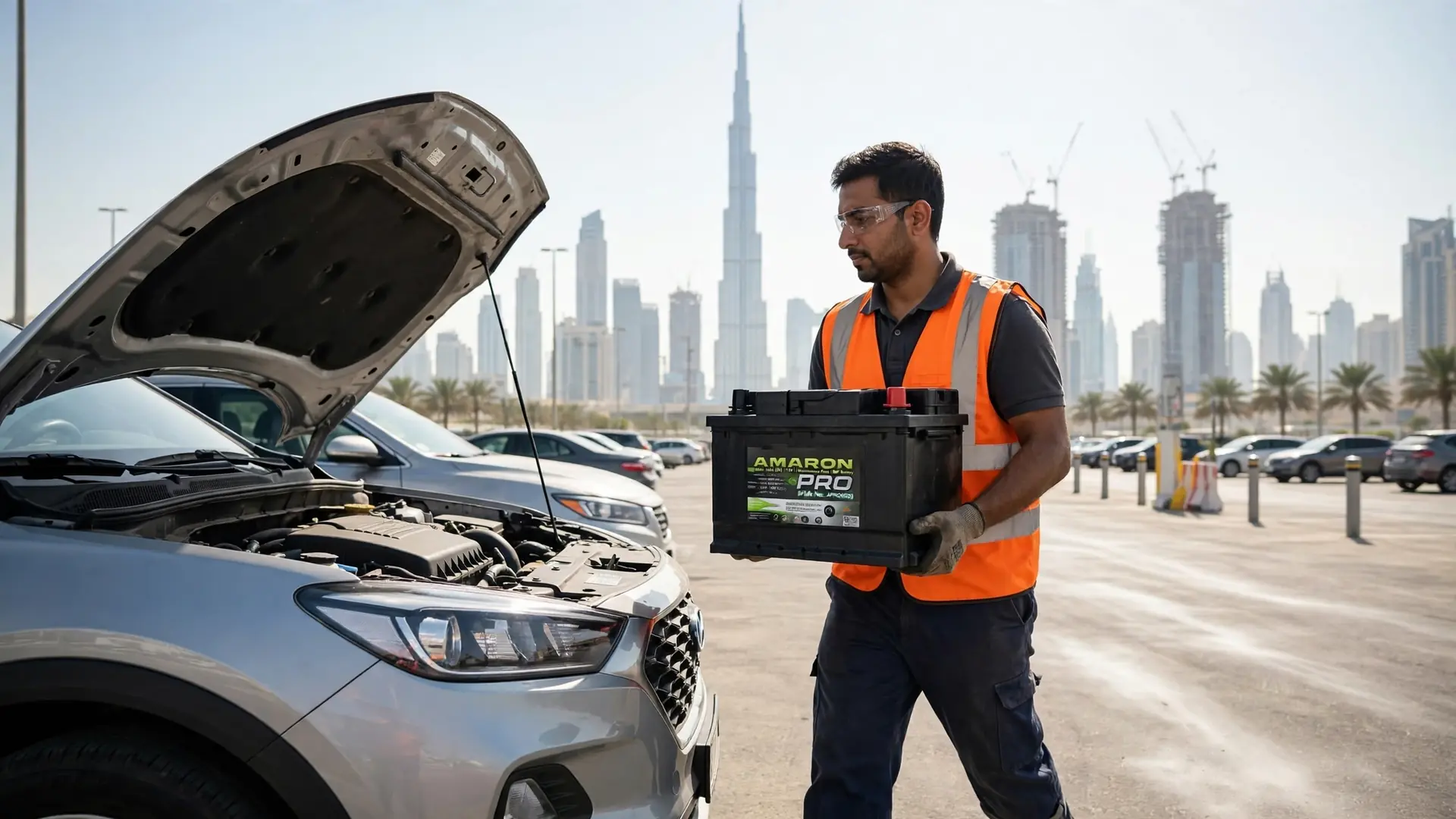
An Amaron car battery lasts 1.5 to 3 years in UAE heat conditions, compared with 3 to 5 years in temperate markets such as the United Kingdom, Germany, and Japan. Ambient temperatures above 45°C double the grid corrosion rate and triple electrolyte water loss.
Amaron inverter and tubular batteries last 3 to 6 years in the same climate with monthly distilled water top-ups. Heat removes 40% to 60% of the rated service life of every flooded lead-acid battery sold in Abu Dhabi, Dubai, and Sharjah.
The Silven X silver-alloy grid used by Amara Raja Energy & Mobility slows that loss. The Silven X alloy does not stop it. Battery temperature, charging voltage, driving habits, and regular inspections all play a role in determining how long an Amaron battery lasts in the UAE.
How Long Does an Amaron Battery Last in UAE Heat Conditions?
An Amaron battery lasts 18 to 36 months in UAE heat conditions, and the driving profile decides the exact figure inside that band. Five usage profiles produce five distinct lifespans.
Usage profile | Average Amaron lifespan | Primary limiting factor |
Daily 30-minute highway commute, basement parking | 36 to 44 months | Grid corrosion |
Mixed city driving, shaded parking | 30 to 36 months | Electrolyte water loss |
Short trips under 15 minutes, open-air parking | 18 to 24 months | Chronic undercharge and sulfation |
Taxi and fleet duty, 12 hours of idling with air conditioning | 12 to 18 months | Deep cycling plus heat |
Weekend vehicle parked outdoors 6 days per week | 12 to 22 months | Self-discharge and sulfation |
Three vehicle categories in the UAE record the shortest Amaron service life: airport-run taxis, delivery vans with permanent-live refrigeration, and second cars parked in open lots at Mussafah, Al Quoz, and Industrial Area Sharjah.
Three categories record the longest: highway commuters between Abu Dhabi and Dubai, villa-garaged sedans, and vehicles fitted with a battery insulation jacket.
Why Does UAE Heat Cut Amaron Battery Lifespan by 50%?
UAE heat cuts Amaron battery lifespan through 5 chemical mechanisms that run faster at 45°C than at 25°C. The Battery Council International records a 50% reduction in lead-acid service life for every 8°C rise in average operating temperature above 25°C. Abu Dhabi summer averages sit 20°C above that reference point.
1. Positive Grid Corrosion Doubles Every 10°C
Lead grid corrosion follows the Arrhenius rate law, so the reaction doubles in speed for every 10°C rise. An Amaron grid that corrodes over 60 months at 25°C corrodes over 15 months at 45°C. The corroded lead layer raises internal resistance, lowers cranking current, and starves the active material of contact with the plate.
2. Electrolyte Water Loss Accelerates Above 40°C
Water leaves the electrolyte through evaporation and through electrolysis during charging. A sealed Amaron Go, or Amaron Flo battery has no refill ports, so lost water never returns. Exposed plate tops sulfate within 30 days and lose capacity permanently.
3. Self-Discharge Rises Fourfold
A calcium-calcium flooded battery loses 1% of its charge per week at 25°C. The same battery loses 4% per week at 45°C. A vehicle parked for 30 days in July at Al Ain drops from 100% to roughly 82% state of charge on self-discharge alone, before parasitic drain enters the calculation.
4. Positive Active Material Softens and Sheds
High temperatures can weaken the structure of the positive active material inside a lead-acid battery. Repeated vibration from driving can cause the weakened material to loosen and fall to the bottom of the battery case. Over time, this shedding can reduce the battery’s capacity and contribute to poor starting performance.
5. Separator Oxidation Opens Internal Shorts
Polyethylene separators oxidise faster at high temperature. Oxidised separators develop pinholes, and dendrites from the negative plate pass through those pinholes. A single shorted cell drops open-circuit voltage from 12.7 V to 10.5 V and ends the battery in one step.
What Temperatures Do Amaron Batteries Face in UAE Engine Bays?
Amaron batteries face electrolyte core temperatures of 55°C to 65°C during UAE summer driving, well above the 25°C reference used in warranty lab testing. Six measurement points explain the gap between ambient forecasts and real battery conditions.
Measurement point | Peak summer reading, June to September |
Ambient air, Abu Dhabi and Dubai | 45°C to 50°C |
Asphalt surface, open parking at 14:00 | 65°C to 75°C |
Cabin interior after 2 hours parked | 60°C to 80°C |
Engine bay after 40 minutes of driving | 85°C to 105°C |
Battery case surface without a heat shield | 60°C to 70°C |
Electrolyte core temperature | 55°C to 65°C |
Three vehicle designs push battery temperature to the top of that range: transverse-engine hatchbacks with the battery beside the exhaust manifold, turbocharged SUVs such as the Nissan Patrol V6 and the Ford Explorer EcoBoost, and any engine bay with a removed or damaged battery heat shield.
Three designs keep temperature at the bottom of the range: boot-mounted layouts on BMW 5 Series and Mercedes E-Class, under-seat layouts, and factory-insulated bays with an intact jacket.
How Does Amaron Silven X Alloy Technology Resist UAE Heat?
Silven X technology resists UAE heat by adding silver to the calcium-lead grid alloy, which raises the corrosion resistance of the positive plate. Silver stabilises the grain structure of the cast grid at elevated temperatures. The stabilised structure resists the intergranular attack that destroys plain calcium grids in hot climates.
Amaron pairs the Silven X alloy with 4 supporting design features: zero-maintenance sealed construction, patented BIC vents for gas release and flame arrest, expanded inter-cell welds for higher cranking current, and factory-charged wet shipment that removes dealer charging variability.
The sealed design removes water top-up from the maintenance schedule on automotive models. The same sealed design removes any option to correct water loss once the electrolyte drops below the plate tops.
Which Amaron Battery Range Lasts Longest in UAE Heat?
The Amaron Pro range lasts longest in UAE heat because it carries the thickest positive plates and the highest published warranty of the automotive line-up. Amaron’s warranty terms list total coverage from 24 to 72 months across models, with pro-rata months included in the total.
Amaron range | Construction | Published total warranty | Common UAE fitment |
Amaron Go | Flooded calcium-calcium | 48 to 60 months | Toyota Corolla, Honda Civic, Nissan Sunny |
Amaron Flo | Flooded calcium-calcium | 55 to 72 months | Hyundai Elantra, Kia Cerato, Toyota Yaris |
Amaron Pro | Flooded, high cranking current | 60 to 72 months | Nissan Patrol, Toyota Land Cruiser, Mitsubishi Pajero |
Amaron Hi-Way | Commercial flooded | 24 to 36 months | Isuzu NPR, Mitsubishi Canter, Tata buses |
Amaron Quanta | VRLA sealed | 24 to 36 months | UPS, inverter, telecom backup |
UAE distributors set local warranty periods below the published international figures. Retail listings in Dubai and Sharjah run 12 to 18 months on automotive models, and Varta and ACDelco listings run 12 to 24 months.
Heat drives that reduction. Confirm the covered period on the tax invoice at the point of purchase, not from an international brochure.
Common Amaron size codes stocked in the UAE include DIN44, DIN55L, DIN66, DIN74, DIN88, 55B24LS, 46B24L, 105D31R, and 115D31R. Terminal layout separates the L and R suffixes, and a reversed terminal layout leaves the positive cable short of the post.
What CCA, RC, and Ah Ratings Suit UAE Driving Conditions?
Cold Cranking Amps at or above the manufacturer figure, Reserve Capacity above 90 minutes, and Amp-hour capacity matched to the original fitment suit UAE driving conditions. The three ratings measure three separate properties.
Cold Cranking Amps (CCA) measures the current a battery delivers for 30 seconds at minus 18°C while holding 7.2 V. UAE roads never reach that temperature. The rating still indicates plate surface area and internal resistance, and a heat-aged Amaron battery loses measurable CCA before it loses starting ability. A conductance tester reading below 65% of rated CCA marks the end of reliable service.
Reserve Capacity (RC) measures the minutes a fully charged battery supports a 25 A load before dropping to 10.5 V. Reserve Capacity above 90 minutes covers hazard lights, cabin fans, and telematics during a roadside wait on Emirates Road.
Amp-hour capacity (Ah) measures total stored energy over a 20-hour discharge. A Nissan Patrol with an aftermarket amplifier and a parking-mode dashcam draws far more standing current than a base Toyota Yaris, so the Patrol takes DIN74 or DIN88 rather than a downsized DIN66.
No conversion formula links CCA to Ah. The two figures describe different discharge rates. Match both to the owner’s manual specification.
What Are the 8 Signs of Amaron Battery Failure in UAE Heat?
Slow cranking, dimming headlights, a swollen case, terminal corrosion, a dashboard battery lamp, repeated jump starts, an electrical smell, and an age above 24 months are the 8 signs of Amaron battery failure in UAE heat.
- Extended crank time. The starter turns for 2 seconds or longer before the engine fires, and the delay peaks at 07:00 after an overnight soak.
- Headlight dimming at idle. Low beams brighten when engine speed rises above idle, which points to a battery no longer buffering the alternator output.
- Swollen or warped case. Heat and overcharging expand the plastic case. A case that no longer sits flat in the tray indicates thermal damage and ends the warranty on grounds of overcharging under UAE distributor terms.
- White or blue terminal deposits. Lead sulfate crystals form around the positive post and add resistance at the connection.
- Battery warning lamp on the instrument cluster. The lamp reports a charging-system fault, which covers the alternator, the voltage regulator, and the battery itself.
- Two or more jump starts in 30 days. A battery that fails to hold charge across a single night has lost cell capacity.
- Sulphur odour near the bonnet. Hydrogen sulphide escapes from a cell in thermal runaway.
- Service age beyond 24 months in the UAE. Age alone justifies a load test at every oil change past the 2-year mark.
How Do UAE Driving Patterns Shorten Amaron Battery Lifespan?
UAE driving patterns shorten Amaron battery lifespan through chronic undercharge across short trips. A cold start consumes 3% to 5% of battery capacity.
An alternator restores that charge over 20 to 25 minutes of steady running at 13.8 V to 14.4 V. A 10-minute trip from a villa in Khalifa City to a supermarket returns less charge than the start consumed.
Three habits accelerate the deficit. Idling with the air conditioning at maximum loads the alternator with the blower motor, the compressor clutch, and 2 radiator fans, which leaves a reduced share of output for battery recharge.
Stop-start traffic on Airport Road repeats the cycle without highway running to compensate. School-run and mall-run patterns of 3 trips per day under 12 minutes hold the battery near 70% state of charge for months.
A battery held below 12.4 V grows hard lead sulfate crystals on the plates. Those crystals resist normal charging. Sulfation removes capacity permanently, and it turns Amaron warranty claims into usage-related rejections rather than manufacturing-related approvals.
How Parasitic Drain Affects Amaron Battery Life
A healthy vehicle typically draws a small amount of current after it enters sleep mode. However, aftermarket accessories such as dashcams, GPS trackers, alarms, and amplifiers can increase the standby load. When a vehicle remains parked for several days, excessive parasitic drain can gradually discharge the battery.
Component | Typical Current Draw at Rest |
ECU and body control module in sleep mode | 20 to 50 mA |
Two-channel dashcam in parking mode | 300 to 500 mA |
Aftermarket alarm or GPS tracker | 25 to 80 mA |
Amplifier wired to a permanent live feed | 100 to 300 mA |
Keyless entry receiver | 10 to 25 mA |
Boot or glovebox lamp with a failed switch | 500 mA to 2 A |
A battery that repeatedly remains partially discharged can experience reduced performance and a shorter service life.
This can be particularly important in the UAE, where high temperatures already accelerate battery aging. If an Amaron battery loses charge while the vehicle is parked, testing the vehicle’s resting current can help identify an electrical drain.
How to Extend Amaron Battery Lifespan in UAE Heat: 12 Steps
Twelve steps extend Amaron battery lifespan in UAE heat conditions:
- Park in shade or basement levels to keep case temperature 15°C below open-lot figures.
- Retain the factory heat shield on every engine bay that carries one from new.
- Fit an insulation jacket on bays without a factory shield.
- Drive 25 minutes continuously at least twice per week to restore the full state of charge.
- Clean both terminals every 3 months with a wire brush and a baking-soda solution.
- Apply petroleum jelly to the posts after cleaning, and keep grease off the connection faces.
- Torque the hold-down clamp to the workshop specification to stop vibration damage.
- Disconnect parking-mode dashcams before airport parking beyond 48 hours.
- Test alternator output at every service, and confirm 13.8 V to 14.4 V at 2000 rpm.
- Measure parasitic drain with a clamp meter when standing losses appear.
- Connect a smart maintainer to vehicles stored longer than 14 days.
- Replace on age at 24 months, ahead of the first Ramadan or summer failure.
How to Test an Amaron Battery in UAE Conditions?
Test an Amaron battery with an open-circuit voltage reading after 4 hours of rest, followed by a conductance test at the rated CCA. Surface charge from a recent drive inflates voltage readings by 0.2 V to 0.3 V, so rest the vehicle in shade before measuring.
Open-circuit voltage at rest | State of charge | Recommended action |
12.70 V to 12.80 V | 100% | No action |
12.50 V | 75% | Recharge within 7 days |
12.30 V | 50% | Recharge immediately, sulfation active |
12.10 V | 25% | Conductance test before further use |
11.90 V or lower | Under 10% | Replace after confirming with a load test |
10.50 V | Shorted cell | Replace the battery |
A load test applies half the rated CCA for 15 seconds. Voltage that falls below 9.6 V during that test fails the battery. A conductance tester reads internal resistance in seconds, reports measured CCA against rated CCA, and a result under 65% of the rating ends the service life. Cranking voltage on a healthy system stays above 10.0 V during engine start.
How Long Do Amaron Inverter Batteries Last in UAE Conditions?
Amaron inverter and tubular batteries last 3 to 6 years in UAE conditions with correct water management. Tubular plates carry more active material than automotive plates, and refillable vent caps allow the water correction that sealed car batteries refuse.
Four maintenance actions keep a tubular battery at the top of that range. Check the electrolyte level every 45 days in summer and every 60 days in winter.
Top up with distilled water only, and stop at the upper float mark. Keep the battery in a ventilated room below 35°C, away from balconies exposed to direct sun. Avoid discharging below 50% depth, because deep cycling below that point strips 30% or more from total cycle life.
Amaron vs Varta vs ACDelco vs Exide: Which Lasts Longer in UAE Heat?
No brand escapes UAE heat, and correct specification separates a 3-year battery from an 18-month battery more than the label does. Four brands dominate UAE retail shelves.
Brand | Grid technology | Reported UAE service life | Typical local warranty |
Amaron | Silven X silver-calcium alloy | 1.5 to 3 years | 12 to 18 months |
Varta | Silver-calcium, AGM and EFB range | 1.5 to 3 years | 12 to 24 months |
ACDelco | Calcium-calcium | 1.5 to 2.5 years | 12 to 24 months |
Exide | Calcium and hybrid ranges | 1.5 to 2.5 years | 12 to 18 months |
Five variables outweigh brand choice in the UAE: the technology match to the vehicle’s charging system, the manufacturing date of the stock sold, the health of the alternator and voltage regulator, the parking environment, and the average trip length.
A correctly specified Amaron Pro on a garaged highway commuter outlasts a premium AGM battery on a short-trip vehicle parked in open sun.
AGM vs EFB vs Flooded: Which Type Survives UAE Heat Longest?
Enhanced Flooded Batteries (EFB) and Absorbent Glass Mat (AGM) batteries survive UAE heat longer than conventional flooded batteries on start-stop vehicles, and the correct answer follows the vehicle specification rather than the price list.
AGM batteries hold the electrolyte in glass mat separators. They resist vibration, accept charge quickly, and support heavy electrical loads on models such as the Mercedes GLE, the BMW X5, and the Range Rover Sport. Sustained heat above 50°C shortens AGM life sharply, because a sealed AGM cell loses water without any route to replace it.
EFB batteries upgrade the flooded design with a polyester scrim on the positive plate. They deliver more cycles than plain flooded units and cover entry-level start-stop systems on the Toyota Corolla Hybrid and the Hyundai Tucson.
Conventional flooded batteries suit vehicles without a start-stop system. Fitting a flooded battery to a start-stop vehicle shortens life to 12 months or less and voids the warranty.
Match the replacement to the original technology. Downgrading from AGM to flooded on a vehicle with regenerative charging control damages the new battery within one summer.
When to Replace an Amaron Battery in the UAE?
Replace an Amaron battery in the UAE at 24 months of service, or earlier when a conductance test reports under 65% of rated CCA.
Four conditions justify immediate replacement regardless of age: a swollen case, an open-circuit reading of 10.5 V that indicates a shorted cell, a failed load test at half the rated CCA, and a second jump start inside 30 days.
Timing matters in the Emirates. Replace ahead of June rather than during August, because heat exposes a marginal battery at the worst moment. A battery that starts a car in February at 22°C fails in July at 47°C with no further warning.
How to Verify an Amaron Battery Date Code and UAE Warranty?
Verify an Amaron battery through the manufacturing code printed on the case, the hologram on the label, and the stamped warranty card issued with the tax invoice. Stock that sits 8 months in a Sharjah warehouse arrives with a partly self-discharged and partly sulfated plate set.
Four checks protect the purchase. Read the manufacturing month and year on the case before payment, and reject stock older than 6 months. Confirm the hologram and the batch record with the seller.
Collect a warranty card stamped with the dealer name, the model code, and the date of sale. Keep the tax invoice, because Amaron warranty claims require both the invoice and the card.
Warranty exclusions across UAE distributors cover 5 conditions: physical damage to the case, incorrect installation, unauthorised repair, deep discharge from a vehicle fault, and use outside the rated application.
The free replacement stage and the pro-rata stage carry separate rules, and the Amaron battery warranty explained guide sets out both stages with the full exclusion list and the claim steps. Alternator overcharging damages the battery and falls outside the warranty, which makes a charging-system test at fitment worth the 10 minutes it takes.
Frequently Asked Questions About Amaron Battery Lifespan in UAE Heat
An Amaron battery lasts 1.5 to 3 years in Dubai. Garaged vehicles on daily highway commutes reach 3 years. Short-trip vehicles parked in open lots reach 18 months.
No. Amaron automotive batteries in the Go, Flo, and Pro ranges use sealed zero-maintenance construction with no refill ports. Amaron tubular and inverter batteries accept distilled water and require a level check every 45 days in summer.
An open-circuit reading of 11.9 V or lower indicates a discharged battery, and 10.5 V indicates a shorted cell. Confirm both readings after 4 hours of rest and with a load test before replacement.
Yes. Shaded parking holds the battery case 15°C to 20°C below open-lot temperature. That reduction alone adds 6 to 12 months of service life across a UAE summer cycle.
A fully charged Amaron battery on a vehicle with 50 mA parasitic drain holds a startable charge for 21 to 30 days in summer. A dashcam in parking mode reduces that window to 3 days.
No. A swollen case indicates overcharging or extreme heat exposure, and UAE distributors classify both as usage conditions outside the warranty. Test the alternator output before fitting a replacement.
A Nissan Patrol takes DIN74 or DIN88 sizing with 680 CCA to 800 CCA, subject to the exact model year and engine. Confirm the figure against the owner's manual and the original battery label.
Both brands report 1.5 to 3 years of UAE service life. The Silven X silver alloy gives Amaron a corrosion-resistance advantage on paper. Trip length, parking environment, and charging-system health decide the outcome more than the brand badge does.
Key Figures at a Glance
- 1.5 to 3 years: Amaron automotive battery lifespan in UAE heat conditions
- 3 to 6 years: Amaron tubular and inverter battery lifespan with correct water top-ups
- 50%: service-life reduction for every 8°C rise above 25°C
- 55°C to 65°C: electrolyte core temperature during UAE summer driving
- 50 mA: healthy parasitic drain ceiling at rest
- 12.4 V: threshold below which sulfation starts
- 65% of rated CCA: conductance-test result that ends service life
- 24 months: age at which UAE replacement planning starts
Book a battery health check with a conductance test, an alternator output reading, and a parasitic drain measurement before the summer peak. Three measurements taken in 20 minutes replace one roadside failure at 47°C.
Battery Zone UAE supplies fresh-dated stock across Dubai with 24/7 fitting and registered warranty support. Order a genuine Amaron car battery with on-site installation and a charging-system test at the point of fitment.